Every business wants its HR team running on peak efficiency (hello 'do more with less') and new tech always feels like it must be the way forward. Never more so than with AI. Between vendors and business leaders, HR teams are bombarded with a push to adopt AI. So why is it that, no matter how much you want to, you just can’t seem to bring the utopia that all the slick demos promise to life? Why isn’t your team getting predictive insights and automating everything and letting AI do everything you don't want to?
Truthfully? You're not ready.
As an industry, we're woefully behind on tech adoption. A lot of teams are still out there using spreadsheets for everything, without a central point of data and with a surprising amount of physical paperwork. We're still getting requests to help teams move to the cloud. And one of the biggest challenges we see is with teams wanting to use AI, but not having usable data to feed it. All of these teams have further to go on the journey toward being fully AI-ready. Because it's everywhere, we tend to forget that setting up AI properly is an advanced tactic.
To help businesses understand the full scope of what it takes to be ready for advanced tech, we created the Silver Cloud Digital Maturity Model. This breaks down the different steps to readiness into more digestible, achievable stages.
Here’s what it looks like at a glance:
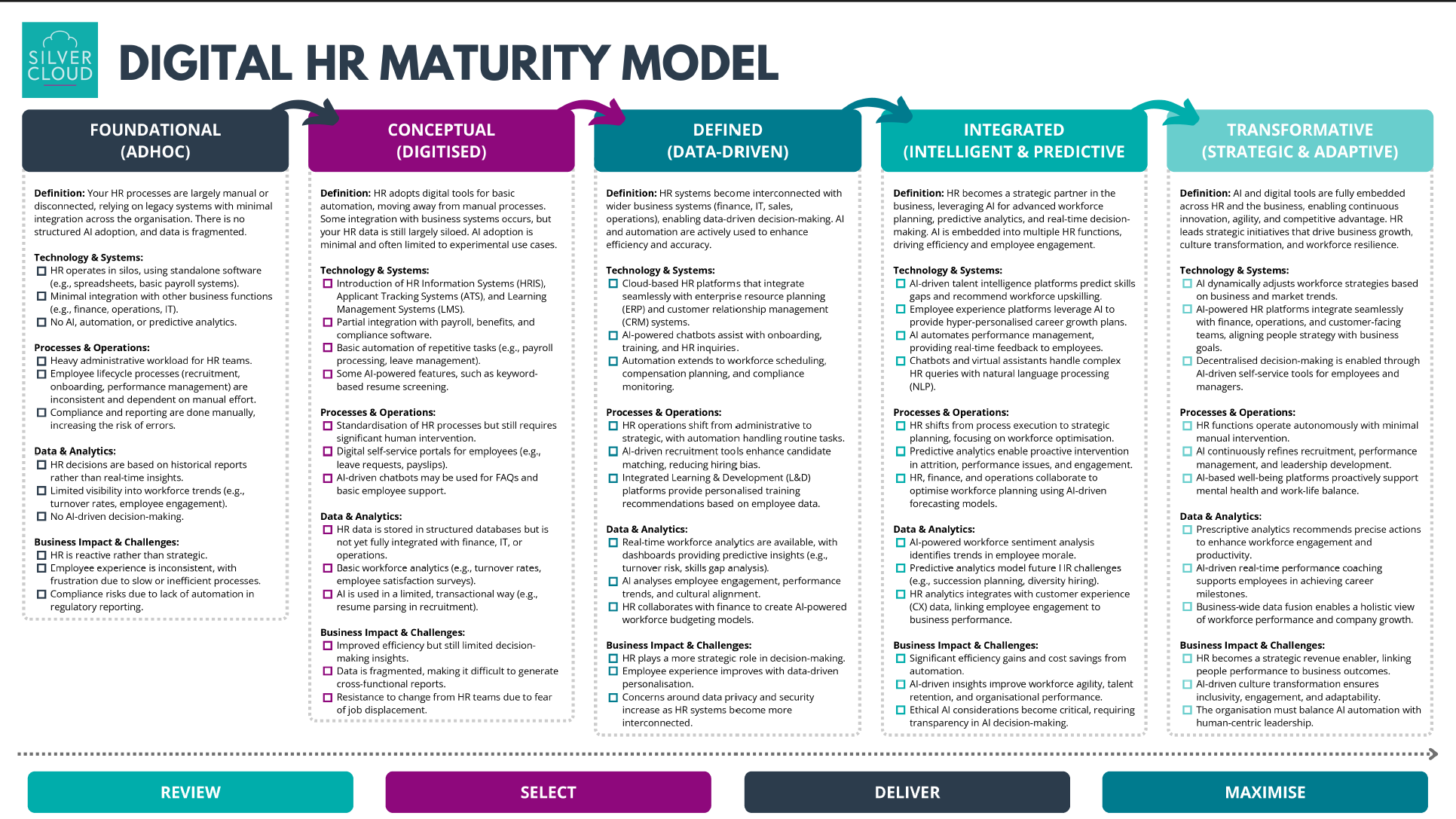
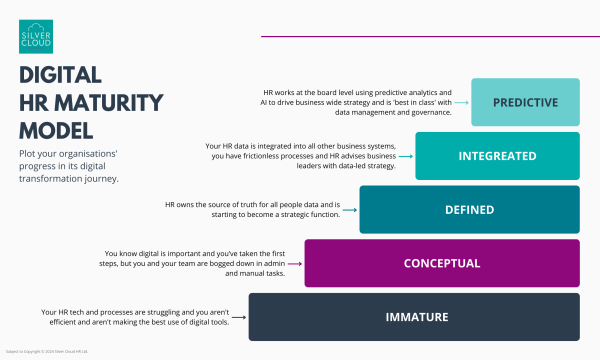
As you can see, the model starts at ‘immature’ and moves up all the way through to ‘transformative.’ That final stage is when you can finally make full use of the available technology, including predictive analytics, artificial intelligence and complex automated workflows.
Want to see the full digital maturity model? Click here to get your copy
But even once you see where you’re going, there can be hidden barriers preventing you and your team from making the most of your HR tech. Here are the top five reasons your business hasn’t made it to the transformative stage:
Ignoring the basics
One of the biggest reasons that an organisation struggles to climb the ladder is ignoring the fundamental changes needed and trying to jump ahead. A lot of business leaders get excited about shiny new things (like AI) and demand that their teams start implementing them right away. Without checking to see if the business is really ready for something like that.
When this happens, teams that are still using manual spreadsheets and don’t have consistent or robust data are being tasked with creating something out of nothing, really. The very first step in moving forward is to get your data sorted out. No amount of excitement can overcome missing the foundational actions every business needs to take.
To avoid this, think data first. That means HR having and owning a cohesive, single source of truth for your people data. Then auditing it regularly so you can address any incomplete or poorly formatted input. And, of course, documenting your processes as they currently exist. This is what sets you up for taking the next step and taking advantage of new technology. It cannot be ignored or you’ll run into even worse blockages further along the maturity model.
Read more: People migration data – how to keep it from sucking
Change fatigue
Along those same lines, businesses that try to do it all in one go also tend not to reach a transformative state. That’s because of something we call ‘change fatigue.’ Change fatigue happens when there are so many things that a business tries to do in one go that everyone involved just gets overwhelmed and disinterested.
This can happen when a business tries to climb the model too quickly. Maybe looking to move from Conceptual to Predictive in one fell swoop. The number of changes to internal systems, processes and even people needed to get there means your employees never get to fully rest and get comfortable with each new thing. Doing things this way is a good way to make adoption rates plummet.
You can overcome this challenge by taking things slowly and creating a practical change management timeline. Be sure to give your employees enough time to get to grips with each new change before moving onto the next step. It's also key to think about the full journey ahead of you. Although we present it in a linear fashion, the most effective path forward for your business is one tailored for your business.
Mismatched ambition
There are also some organisations that just don’t have a true need for a transformative HR team. Sure, having all of these insights easily to hand would be great and getting HR a seat at the table is amazing. But maybe you actually work for quite a small business and stopping at the Integrated level is more than enough to do your best work. Or maybe you could make Transformative really work for you, but the rest of your business doesn’t have its data under control to the same degree.
In these situations, it can be really beneficial to take a step back and really think about your business’s goals and needs before moving forward with a project. Where do you actually need to get to in order to achieve your strategic goals? And is there a case for creating multiple phases of your transformation? Maybe you don’t need the whole shebang yet, but you’re sure you will. Consider defining clear triggers for when you need to take the next step so you can stay on top of your needs.
Learn more: Discover your AI-readiness score - take the digital maturity quiz!
Competing priorities
Situations like the above make HR transformation projects especially vulnerable to competing priorities. When there isn’t a clearly defined and pressing need for the business to take certain steps, other projects are going to get in the way. Whether that is from the side of the wider business or within the HR team itself.
A great way to counter this is to go through and put together a very thorough business case that clearly defines the scope and benefits of this project. Doing this can help your project stand out over other possible priorities. If you need help, we’ve put together a useful guide and template for creating an unbeatable business case.
Another tactic that might help is exploring what elements of AI-readiness would help all parts of the business. The more you can help other departments achieve their goals, the greater success you'll find in gathering support for your intiative.
Lack of investment
This is a hard one. Sometimes, you’re just not able to put enough into a project to make it a success. Whether that’s money, time or people, any lack of investment can leave your path up the digital maturity model barred. This can happen for a couple different reasons.
The first reason is that you didn’t have as much buy-in from leadership as you thought. That can lead to tight purse strings and overly lean project teams. The best way to tackle this issue is to have taken that step above and developed a really strong business case. One that brings your stakeholders along the journey and makes them see why this is worth it.
Another reason this can happen is projects going over budget because of issues like scope creep (where more and more is being added to the scope of work) and surprise hurdles like data integrity issues - another key reason to get your data in order before tackling AI.
Fixing scope creep requires a very clear project plan that you, your team and your implementation partner (if you use one) are all committed to. That means defining your what is included in this project and what isn't, sticking to that plan and making sure there is room to flex in your timelines. Expect the unexpected.
Data problems actually goes back to the first point. Don’t skip the basics. Get your data in order as the first step. Then add more complexity from there. As long as your foundations are strong, you’ll have the stability you need to build going forward.
Conclusion
As you can see, there can be a lot of barriers preventing your business from becoming a well-oiled HR machine. From not getting the basics down to not getting enough people and finances on board. But you can overcome these by tackling your tech in a well-thought out, methodical way. Identifying where you sit on the digital maturity model is the first step you need to take. From that point, it’s a matter of choosing where you want to get to and plotting a realistic path to get there.
If this is something you’re struggling to do on your own, the Client Transformation team here at Silver Cloud can help. With years of experience, they are skilled at helping HR teams develop the data, processes and tech stack that they need to become their most effective.
Ready to see how your HR processes stack up? Talk to us about a Digital Review to kickstart your tech journey.